

Quality Treatment With Super Affordable Price
Best Physiotherapy Treatment India

Call us anytime
Write a mail
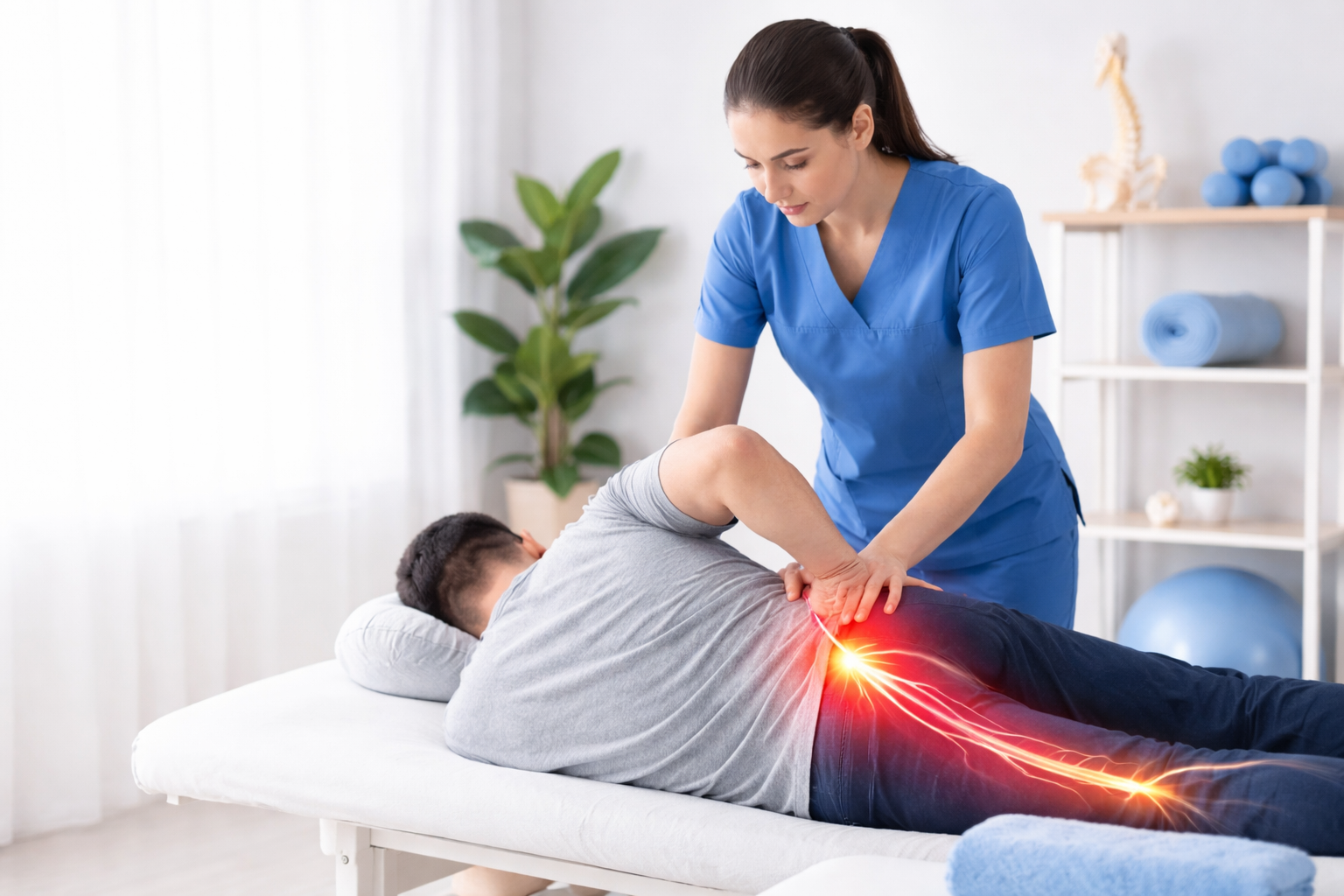
If you’ve spent months treating the wrong problem — trying rest, painkillers, or a generic exercise routine from YouTube — you’re not alone. Lower back pain is one of the most common musculoskeletal complaints people seek help for, and it’s also one of the most frequently mismanaged. For anyone considering back pain physiotherapy in Gurgaon, the question isn’t just “does your back hurt?” — it’s whether that pain is mechanical, whether a nerve is involved, and if so, which one and why. If you have sciatica, you need a very different approach from someone with straightforward back pain. Applying standard back pain protocols to a compressed sciatic nerve can actually make things worse. And if you’re dealing with lumbar spondylosis that’s been progressing quietly for years, you need a long-term management mindset, not a six-session discharge plan. Here’s how to tell these conditions apart and what good physiotherapy actually looks like for each. Back Pain Physiotherapy Gurgaon – Causes and Symptoms “Back pain” isn’t a diagnosis. It’s a description — a catch-all that can mean anything from a strained erector spinae to a misfiring facet joint to a disc that’s slowly drying out. That ambiguity is part of what makes it so difficult to treat without a proper assessment. Prolonged sitting loads the lumbar discs with standing pressure. That’s why desk workers and drivers are so commonly affected. Muscle imbalances, poor lifting mechanics, and weak deep stabilizers all contribute — but your context matters enormously. A 28-year-old who spends 10 hours a day at a laptop has a different problem from a 55-year-old who’s been lifting heavy loads for decades. Symptoms that typically suggest mechanical back pain: Back pain physiotherapy in Gurgaon starts with a thorough movement screen — not a questionnaire, but an actual physical assessment. Joint mobilization, targeted core activation (usually beginning with dead bugs or transverse abdominis work before moving to load-bearing exercises), and a proper ergonomic review are the foundations. If you address both the clinical and occupational sides of the problem, you’re far more likely to see genuine improvement within two to four weeks, rather than cycling through flare-ups indefinitely. If your pain stays above the knee and there’s no change in bladder or bowel function, conservative physiotherapy is the right starting point almost every time. Sciatica Physiotherapy Treatment in Gurgaon – What You Need to Know Sciatica isn’t just bad back pain. The sciatic nerve — originating from the L4/L5 or S1 nerve root, running through the piriformis region, and tracking down the leg — produces a very specific symptom pattern when it’s compressed or chemically irritated. You might describe it as electric, burning, or like a hot wire running down your leg. That language alone is clinically telling. What sciatica actually looks like: Sciatica physiotherapy treatment in Gurgaon is built around decompressing the nerve root and correcting the source of irritation. Clinically, that includes neural mobilization techniques such as sciatic nerve flossing, lumbar traction where appropriate, and progressive core loading to reduce the mechanical pressure contributing to compression. Cold packs in the acute phase before introducing deeper manual work is a standard sequencing choice — the inflamed nerve tissue needs that initial window. Here’s the part that gets skipped too often: sciatica is a symptom, not a standalone condition. If your assessment doesn’t identify whether the driver is a herniated disc, piriformis syndrome, or lumbar stenosis, the treatment plan is guesswork. Treating the leg pain without addressing its source means you improve temporarily, then find yourself back at square one three months later. Slip Disc Physiotherapy Gurgaon – Diagnosis and Treatment A herniated disc — what most people call a slip disc — occurs when the nucleus pulposus pushes through a fissure in the outer annulus. At L4/L5 or L5/S1, the two most common lumbar levels, this puts direct pressure on a nerve root. The resulting symptoms follow a predictable dermatomal pattern, which is actually useful diagnostically. Signs that point toward disc herniation rather than simple muscle strain: A herniation can be clinically suspected, but you can’t confirm the level or rule out other pathology without an MRI. Once you have imaging, slip disc physiotherapy in Gurgaon is the appropriate first-line response for mild to moderate herniations. Surgery enters the conversation only when there’s progressive neurological loss or bowel and bladder involvement — a small minority of cases. Treatment moves through stages. Early on, the focus is pain management using positions of comfort and gentle isometric work. As irritability settles, McKenzie-based extension exercises or lumbar traction may be introduced if your disc responds to centralization. Later, progressive spinal stabilization — bird-dog, dead bug, partial bridges — builds the support structure the disc needs to stay protected under load. If you work through this consistently without rushing the progression, you have a strong chance of avoiding surgery even with a confirmed herniation. Lumbar Spondylosis Physiotherapy Gurgaon – Managing a Chronic Condition Lumbar spondylosis is age-related wear — disc desiccation, osteophyte formation, facet joint arthritis. It shows up on MRI in most adults over 50, which is worth keeping in mind when interpreting scans. Imaging findings and pain levels don’t always correlate. Some people have significant degenerative changes on MRI and function well; others have relatively mild changes but are severely limited. The scan tells you the anatomy; it doesn’t tell you the full story. What the symptom picture tends to look like: Lumbar spondylosis physiotherapy in Gurgaon isn’t about reversing degeneration — that’s not possible. The realistic goal is meaningful symptom control, preserved function, and slowing further decline through appropriate load management. Low-impact aerobic conditioning (hydrotherapy or cycling both reduce joint stress while maintaining cardiovascular load), targeted spinal mobility work that avoids provoking nerve symptoms, and strength training for the glutes and paraspinals are the practical cornerstones of long-term management. If you treat this as a short course of physio and then stop exercising, symptoms almost universally return within months. This condition rewards consistency over intensity. Getting the Right Diagnosis Matters Overlapping symptoms


Quality Treatment With Super Affordable Price
Call us anytime