


Quality Treatment With Super Affordable Price
Best Physiotherapy Treatment India

Call us anytime
Write a mail
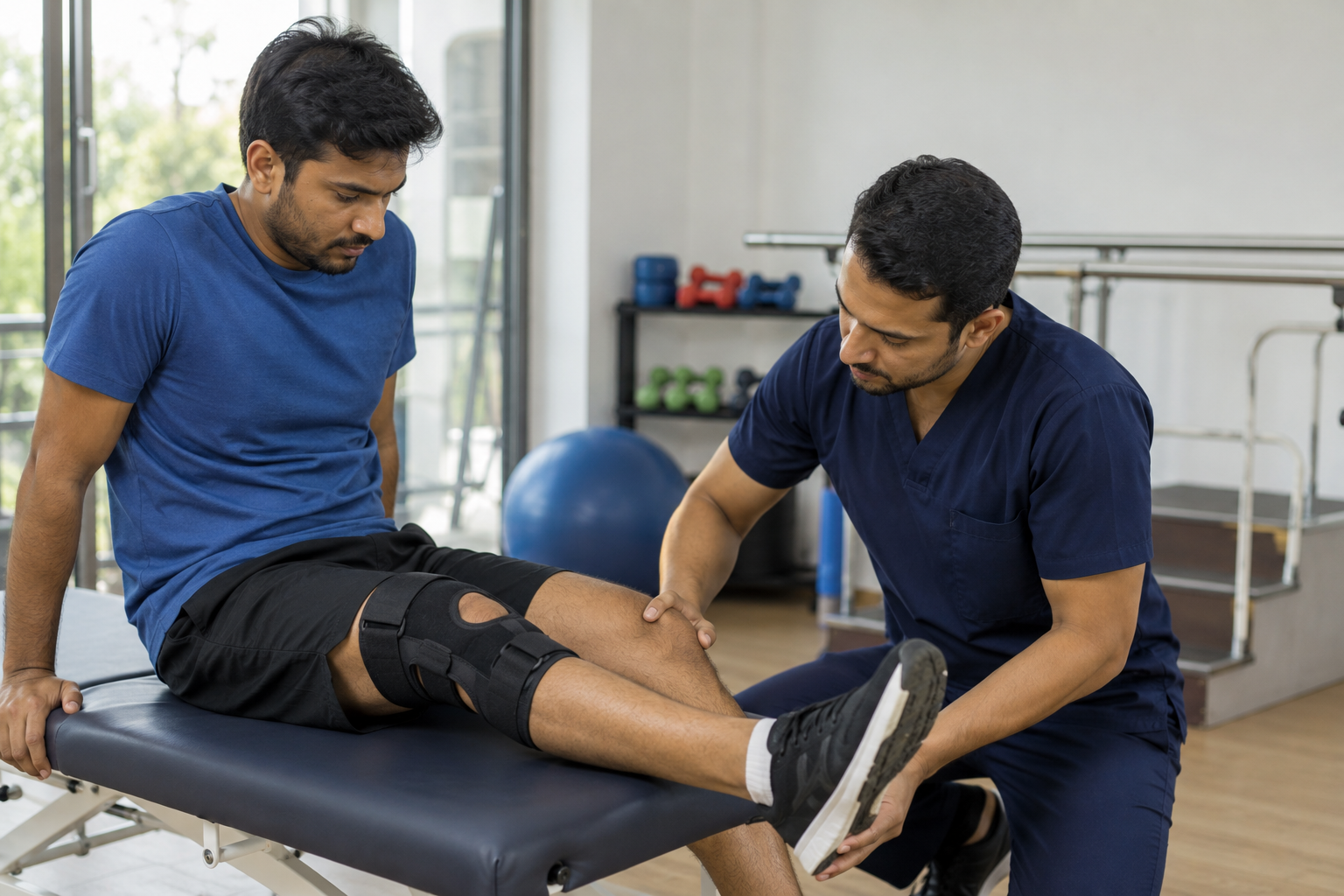
We’ve seen athletes walk into a clinic six weeks post-surgery convinced they’re “almost there,” only to find their quad is firing at 60% of the healthy side. ACL Injury Physiotherapy Treatment in Gurgaon isn’t just about getting someone back on their feet — it’s about getting them back to sprinting, cutting, and competing without that creeping fear of the knee giving way again.
Gurgaon has developed a genuine concentration of sports physiotherapy clinics capable of handling these cases well. A club-level badminton player and a semi-professional football midfielder will have different demands, different timelines, and different risks. Knowing what recovery actually looks like — phase by phase, milestone by milestone — puts you in a far better position to choose where you get treated and how hard to push.
Sports physiotherapy treatment in Gurgaon has matured significantly over the past decade, partly because athletes have stopped accepting generic care and started asking better questions. Sports physiotherapy isn’t just musculoskeletal physiotherapy with a different name. It’s built around athletic movement mechanics, sport-specific load demands, and what it actually takes to perform at intensity without breaking down.
When a sports physiotherapist looks at your knee, they’re really looking at your whole lower limb chain. Key factors they assess include:
Treat the knee in isolation and you’re leaving the door open for the same injury to happen again.
A solid clinic offering sports physiotherapy treatment in Gurgaon will use manual therapy alongside exercise prescription that’s calibrated to your current load tolerance — not a fixed protocol pulled from a textbook. And they’ll explain what you can and can’t do at each stage, and why. If a clinic hands you a printed sheet of exercises and waves you out the door, that’s not sports rehab.
ACL injury physiotherapy treatment in Gurgaon follows a phased structure regardless of whether you’ve had surgical reconstruction or you’re taking the conservative route. What matters is that each phase has objective exit criteria. You advance when you hit measurable benchmarks — not just when a certain number of weeks have passed on the calendar.
In the first four to six weeks, the focus is on:
After that comes strength work and neuromuscular re-education. Single-leg squat progressions, lateral band loading, and proprioceptive drills on unstable surfaces help rebuild the brain-to-joint control that the injury disrupted. Most orthopedic sports medicine protocols set 90% limb symmetry on isokinetic strength testing as the threshold before cutting or jumping drills are introduced. For ACL reconstruction patients, that benchmark typically falls somewhere between months six and nine — though graft type, pre-injury fitness, and how consistently the early phases were managed all shift that window.
Don’t let anyone clear you for sport based on how the knee “feels.” Ask for the hop test scores. Ask for the isokinetic data.
Ligament injury physiotherapy in Gurgaon isn’t all ACL cases. The knee has four major ligaments — ACL, PCL, MCL, and LCL — each resisting different directional forces. Damage to any of them changes joint loading patterns and movement quality in ways that don’t always show up as obvious instability during daily activity but become very obvious at sport intensity.
MCL injuries, particularly Grade I and II sprains, often recover without surgery. A well-structured program with appropriate bracing and graded loading can return lower-grade MCL injuries to sport in four to eight weeks. PCL cases need more caution early on — resisted knee flexion has to be limited in the initial weeks to avoid pulling the tibia posteriorly while the ligament is still healing.
Grading matters more than most patients realize. Here’s a quick breakdown of what each grade typically means for your program:
Ask your physiotherapist to explain your injury grade clearly, what it means for your recovery window, and what you’ll need to demonstrate before each phase advances.
Identifying the best sports physiotherapist in Gurgaon comes down to whether they can actually speak to your sport and your specific injury — not just knee injuries in general. Some practical things to look for:
For competitive athletes, coordinated care between the physiotherapist, orthopedic consultant, and coaching staff makes a real difference at every transition point in rehabilitation. When those three parties aren’t talking to each other, decisions get delayed and important clinical signals get missed.
Return-to-sport clearance isn’t one conversation — it’s the result of several tests taken together. Hop tests measure functional power and confidence. Isokinetic assessments quantify how close the injured leg is to the healthy one. Tools like the ACL-RSI scale screen for fear of re-injury, which research consistently shows is one of the strongest predictors of whether an athlete will actually perform at full intensity once cleared.
Sport-specific drills need to be introduced progressively and under observation before an athlete steps back into live competition. A sensible return-to-sport progression typically looks like this:
Athletes who skip that intermediate step and go straight from gym work to full-contact training have measurably higher re-injury rates in the first season back.
Pressure to return early — from coaches, club commitments, or the athlete themselves — should never override objective data. The best physiotherapists we’ve seen hold that line even when it’s uncomfortable.
ACL and ligament recovery doesn’t move in a straight line. Some phases go faster than expected. Others stall and need reassessment. Setbacks happen, and they’re not necessarily signs that something is wrong — often they’re just the program catching up with where the tissue actually is.
Most athletes who go through a well-structured rehabilitation program do return to their sport. Many come back with better movement quality than they had before the injury, because rehab forces a level of body awareness that regular training rarely demands.
If you’re working through a knee injury and want structured, evidence-based care in Gurgaon, visit the Gold Medal Physiotherapy website to learn more about their sports physiotherapy treatment in Gurgaon and how their team approaches ACL and ligament rehabilitation through to full return to sport.


Quality Treatment With Super Affordable Price
Call us anytime